TEC Resource Center

  • About
    • Meet the Team
    • Testimonials
  • Blog
  • Contact
  • Home
  • Planning
  • Training
    • The Manager’s Toolbox
    • Custom Training
  • Support
  • Events
  • TEC Franchise Center

November 30, 2022 By Pat Meehan

It’s That Time of Year!


No, it is not the holiday season, it is the time of year to look at what your company has done and plan for what it will do over the next three to five years.  I work with countless business owners who before we met thought year end planning was a waste of time.  We have been doing the same thing for years and we are just fine!  It’s a waste of time and money to get the entire team together to think about what might happen!  My favorite is – Forecasting and budgeting is a waste of time, we never get it right anyway!

Does any of this sound familiar?  Spending some focused time and effort this time of year to better analyze what happened last year, both in your company and the industry has benefits far beyond creating Key Performance Indicators (KPI’s) to measure success against in the future.  The fact is most companies large and small fail to hit the bullseye when it comes to forecasting.  If you have any money in the stock market this year you know that’s true.

Planning is about the agility and alignment of you and your organization.  As the owner you know where you want to go, that’s why you started the business.  Knowing which path to take to achieve the quickest results and having everyone onboard rowing in the same direction is where planning and budgeting comes in.

Imagine sailing to a Caribbean Island from New York without a navigational map or instruments to predict the weather, direction, or speed.  For the millennials out there, planning a road trip without your phone might be a better analogy.  Of course, we wouldn’t even think about doing these things.  Then why would you try to build a business without an up-to-date GPS to help guide the way.

Take time in the month of December to run the numbers, analyze the changes in the market and yes, get feedback from your team as to what they see as the best way forward.  Captain Kirk could never have survived without Scottie and Spock helping find the right path.  As the owner the responsibility to move the company forward is yours, but your team will be more loyal and work harder to make the journey a success if they helped create the plan to get to the destination.

Here is to a successful 2023.  All your dreams and wishes will come true if you plan it that way and get everyone aligned around the KPI’s that will guide you to your destination!  Let’s Get It Done!

Filed Under: Alignment, Business Ownership, Performance Tagged With: #Newopportunities, management, performance, Planning, setting expectations

September 29, 2022 By Pat Meehan

Lets’ Talk About Vendors

The vendors you work with are important to the success of your business and the relationships you build with them can drastically impact your top and bottom line.
Vendors and Cost of Goods:
First and foremost, your Cost of Goods (COGS) are directly impacted by what your vendors charge you for the components that go into the delivery of your product or service.  Revenue – COGS = Gross Profit.  If you have strong relationships with your vendors, you can drive costs down as your volume grows increasing your overall gross profit.  This can only happen if you understand how your vendor’s cost structures work.  To do this you need to be able to connect with them regularly to discuss how you can help each other grow.  After all nobody wants you to grow more than the vendor that supplies you. Here are a few things I would recommend when dealing with your vendors.
Go to see them or have them come see you so you can both get a better sense of how you can grow together.
Set goals for the relationship in terms of growth incentives, payment and volume discounting.
Meet at least once a year to review the status of the relationship and their competitiveness in the market. The market changes from year to year, so they need to know you are on top of things.
Lastly, track the effectiveness of their product and service. After all, your business is directly impacted by both quality and delivery times.
Vendor Referral Programs:
A good vendor can be one of your best referral sources.  Their success is directly affected by your industry after all and more directly your success.  The faster you grow the faster they grow.  With that in mind explore the possibility of them helping you grow through referrals. Look for unique ways to offer your vendors rewards for helping grow your business and everyone wins.
Here’s the step-by-step process to putting together a partnership with a vendor:
Approach all the vendors you work with and offer them an incentive based on performance.
Put the generous incentive plan together from their perspective, even take suggestions.
Develop a clear, concise and easy to track incentive plan. They need to understand how they will get paid for their efforts.
Encourage subsequent sales instead of focusing only on the initial sale. Creating an incentive trail allows them to continue to reap the rewards of their efforts past the initial purchase, which is usually the smallest sale volume.
Create an incentive plan that’s irresistible to your vendors by offering generous, exclusive compensation.
Think of all the vendors you work with and the creative ways you can put together an incentive plan that entices them to be part of your business. Use their talents, capabilities and connections and you’ll both be winners.
Putting together an incentive plan doesn’t have to be a complicated process. Use our FREE test drive to come up with some great ideas and put your incentive plan together for maximum results.

Filed Under: Performance, Strategic Planning Tagged With: management, performance, setting expectations

October 13, 2017 By Abbe Meehan

Do you have the right people on the bus?

Do you have the right people on your team, and are they sitting in the right seats? Often managers find they have wonderful people working for them. They are dedicated and they work hard. Still, though, they are not getting the results they want from their team. The sad truth is that they may be wonderful, hardworking and dedicated, but they may not be right for the job.

I had a client that was so distraught over his hiring record. He said he always felt he picked the perfect person. His favorite saying was, “They looked so good on paper.” On the interview they seemed so gung ho. He felt hopeless.

Sometimes you meet a person who is really nice, the life of the party, and deep down a really good person, however, you don’t immediately move in together or get married. No matter how fun or well-meaning they are, you have to know you will be good together and work well together to build the life you want. I think this is how Match.com became so successful!

Your work relationships should be regarded in the same way and it starts before the interview process. Selecting the right people to help you build your business or run your department is key to YOUR success. You need to spend time in this process to avoid wasting time later. Here are some tips on how to improve your success rate in selecting the best candidate for your position:

Prepare for the hiring process:

Make sure you understand the Knowledge, Skill and Abilities (KSA’s) the candidate must possess to be successful in the job. Identify the MUST HAVES and the NICE TO HAVES. Write these things down so you can base your questions around them and then rate your candidates after each interview based on these areas. What attributes and values must the candidate embody to add to the overall culture of the organization? Look carefully at the team they will become a part of and understand the behavioral style that will best augment that team.

Review resumes:

I’m assuming you have a job description for the position, so first review it and see if it needs to be tweaked a bit. Review the resumes first to see that the candidate meets the qualifications keeping in mind the KSAs. If you are lucky enough to have too many resumes, start narrowing them down by the MUST HAVES and NICE TO HAVES. Then look for any red flags on the resume:

  • Overall appearance
  • Blanks and omissions
  • Gaps in time
  • Overlaps in time
  • Inconsistencies between education and experience

Create Powerful Questions

This is the most important piece in my opinion. Think about the interview as a time to get to know the person. You really want to see what they are made of. Did they really do the things they have listed on their resume? I’m not saying people lie, but…………. Powerful questions allow you to confirm what is on the resume, so make them count. Ask open ended questions that cannot be answered with a yes or a no. So don’t say, “Are you familiar with……” They know the answer you want is yes, and you really won’t be able to tell if they really have experience with it. Ask them something that will demonstrate knowledge, like, “Can you tell me the biggest issue you have experienced with……..”

Make your choice:

Ask the same questions to each applicant based on the KSAs and MUST HAVES and NICE TO HAVES. Your follow up questions will vary of course, based on their answers. Make yourself a little grid and rate how each candidate did on each base question. Then come up with a total rating. This will help you choose who is statistically best for the job, not who you like best.

Nobody’s perfect

On a personal note, this is obviously not fool proof. People have become very skilled at interviewing due to all the resources that are now readily available to them. But I’ll bet if you look back at some of your good and bad hires, you will find, YOU had a lot to do with the mistakes or the successes. I once hired someone for an administrative position. On my MUST HAVES I listed proofreading skills. After I hired this woman I liked very much, I realized proofreading was actually a weakness, not a skill of hers. I wondered what happened. I went back to my grid. Sure enough, I only rated her 3 out of 5 on proofreading based on what she told me. I didn’t follow my own advice! Here are 3 common errors people make when interviewing:

  • Leniency Error – You know the candidate or they were referred to you by someone you know. Tendency is to rate him/her higher than deserved.
  • Error of Contrast – Some interviewers tend to compare some traits shown by a candidate with their own traits. May be better to choose someone who has more of what you don’t!
  • Halo/Horn Effect – Initial impression about the candidate (good or bad) cloud the interview. I immediately connected with the person I mentioned above on a personal level. It made me overlook a very important qualification she did not have.

Filed Under: Human Resources Tagged With: management, performance

October 13, 2017 By Pat Meehan

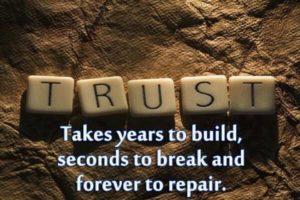
A Foundation of Trust!

“Trust is the glue of life. It’s the most essential ingredient in effective communication. It’s the foundational principle that holds all relationships.” – STEPHEN R. COVEY

I think this statement is essential for every leader to really understand and embody in the everyday relationships they have with their employees.   As a leader you will need to have difficult conversations with your team from time to time and if a foundation of trust is not in place before hand these conversations will be more difficult and less impactful.

I remember a situation I encountered as a young manager that stands out in my mind even today some thirty years later.  I managed a small team of employees in a relatively small company.  We worked hard together and often worked late into the night.  I counted on this team to respond to customer’s calls at two and three in the morning with a smile on their face and urgency for the task at hand.  We worked in the medical industry and our clients and their patients depended on us getting there quickly.  Customer satisfaction was a key performance indicator (KPI) I used to measure the impact my team was having in growing the business.  Happy customers called more often so it was critical that we kept them happy and calling.

One morning I received a call from a customer about one of my best employees.  The complaint was concerning his personal hygiene.  Simply put, he had body odor that was offensive to the staff at the hospital and if not corrected he would not be allowed to service the customer.  I look back at it now and we all knew this was a problem before the customer called.  I hadn’t had the courage to have the difficult conversation necessary to correct an ongoing issue in the workplace.

I went home that night and wrestled with how I would approach this with him in the morning.  Needless to say there was no sleep to be had that night.  In the morning I called the employee into my office and after much small talk about how important he was to the organization I dropped the bomb.  Unexpectedly, he was not upset and in fact he was not even that surprised.  He admitted he had struggled with this problem for a good portion of his life.  Immediately I jumped in and offered to help with some suggestions on ways he could improve the situation – I won’t go into the details here!

A week or two later I had a visit from his wife who wanted to thank me for being there for her husband and helping them both correct a situation that had been a problem for a long time.  I realized then that even though the topic and conversation were of a sensitive nature my team knew that I was coming at it from a place of trust and support.  My goal was to improve their lives and enhance their careers.  They understood I was not only looking out for the wellbeing of the company.

I later developed a saying that I would repeat again and again to all of the leaders in my company – “Lead from the front”.  My meaning was for them to be out there in front of their teams showing them the way by example.  Don’t be that manager that sits in the background letting their staff members take all the risks and do all of the heavy lifting.  Employees need to know first and foremost that you have their best interest at heart.  What you do every day is not for the good of the one but for the good of the many.  I have seen too many leaders get tunnel vision, focusing on their careers, forgetting that the people working for them are the fuel powering the career in the first place.

Trust is the foundation of every relationship.  Without trust there can be no open and honest communication.  My conversation could have gone very differently if my employee thought my goal was to terminate the problem versus resolve it with him as a team.

Feel free to comment below with your stories of how trust made your difficult conversations easier and more impactful!

Filed Under: Leadership Tagged With: management

August 11, 2017 By Pat Meehan

How do you measure performance?

We have all heard the saying – “if it is not measurable it is not manageable.”  Why then do we spend so much of our time managing the softer side of our employees rather than the results they actually achieve throughout the year?  In some businesses it’s all about the statistics of achievement.  In the sport world for example, each member of the team is evaluated on each aspect of their game and ranked against others in the same field.

In the business world some would say that’s just not possible.  I say that’s due to the fact that not everyone on the team understands how they contribute to the overall success of the organization.  Okay, in the sports world it’s easy, right?  Everyone knows what the vision of the organization is – win the championship of course.  There are clear parallels in business but they might not be as easy to define.

Vision

Most businesses have a vision for the organization.  The question is – can it be as clearly defined and understood as winning the championship?  The easy part of the sport world is that the path to the championship has been well defined.  Rules have been set up that allow the manager or owner of the team to build a clearly understood strategy that can then be passed on to the coaches and players.  In your business you can do the same thing!

The first step is to determine your vision for the organization.  Keep it simple!  Keep it measurable!  If it’s not measurable it cannot be managed – Right?  If it’s too complex no one will understand how to break the vision down into departmental and then individual goals.

Vision Statement

In the next Timeframe the company will Attainable Goal by Differentiator!

Most sports teams set out to win the championship but not all of them have the tools and resources to win it this year.  So their timeframe might be to win the championship within the next three years by rebuilding the existing team.  The same goes for your organization.  You might not have the tools on board today to attain the ultimate goal but everyone should understand that’s where you are headed.

SMART Goals

Thankfully the hard part is done right?  Wrong!  Countless businesses I work with have the vision of where they are headed well in hand and simply cannot understand why they haven’t gotten there already.  The long term goal (The Vision) needs to be broken down into yearly, quarterly and even daily goals for each member of the team.  This is a very difficult task and can only be accomplished through strong communication and teamwork within the leadership of the company.  Obviously, the real long term goal of a sports organization is to build the value of that organization by driving up revenue attained from broadcasting rights and game attendance.  Can you imagine if that is what was communicated to the offensive line on a football team?  They would have no way of relating their performance to that high level goal of the organization.  So winning a championship becomes the goal.  Every athlete can relate to this goal and understands what it means to their financial future.

But winning the championship is still too broad a goal to drive performance on the team.  So that goal is broken down further in to win this week’s game and then again into scoring the touchdown.  But it doesn’t stop there!  It’s about first downs – achieving them for the offense and preventing them for the defense.  “If you control the line of scrimmage you win the game.” 

So what are the SMART goals for you team?  How can you break them down into bit size measurable indicators that can be monitored and improved upon each day?

I like to use the example of the airline that wanted to improve on time performance (Goal) in order to raise the overall rating of the airline.  Anyone who travels can understand how this impacts their lives and therefore they pay attention to this rating when selecting their airline of choice.  In turn this will drive revenue for the airline.  So increasing revenue is the high level goal but the employees cannot directly relate to this goal.  Not everyone in your business understands business and therefore you need to make the goals at the employee level relatable to the worker.

But on time performance was still too broad a goal.  This goal was in turn broken down further in to Key Performance Indicators (KPI’s) for the baggage handlers, maintenance workers, gate attendance, pilots and flight attendants.

Baggage Handlers: Have all bags loaded 20 minutes prior to the flight’s departure

Maintenance Workers: Have all flight checks completed 40 minutes prior to flight departure

Gate Attendants: Have all passengers loaded 10 minutes prior to departure

Pilots and Flight Attendants: Arrive at the plane 30 minutes prior to departure

Of course there is more to it than this but for the purposes of our discussion today you can see my point.  These are KPI’s related to the goal that can be reported and monitored to better understand where the weak points in the operation are.  Once identified you can put improvement plans in place that might include training or improved technology to report problems ahead of time.

So start today.

  • Make sure your vision is clear and relatable
  • Ensure the strategy to attain the vision is well thought out and documented
  • Breakdown the goals into (KPI’s) that can be measured at the department and even employee level.

When differences are discovered through the reporting process, don’t shoot the messenger.  Sometimes the process is to blame for good people achieving poor results.  Ask them for their help in fixing the problem.  If you hired the right people, and they understand what they need to do to achieve the goal you will be surprised at what can be resolved if you are willing to listen with an open mind.

Filed Under: Leadership, Performance, Strategic Planning Tagged With: Alignment, management, performance

  • 1
  • 2
  • Next Page »

Connect with TEC online!

  • LinkedIn
  • Twitter
  • YouTube

Recent Articles

  • Q4 Business Planning: Growth Strategies & SMART Goals for the New Year
  • Integrating Business and Personal Life
  • Your Business Exit Strategy – 5 Things to Consider
  • Empowering Growth Through Accountability
  • Part 11 – Performance Measurement

Search for Articles by Topic

Recent Articles

  • Q4 Business Planning: Growth Strategies & SMART Goals for the New Year
  • Integrating Business and Personal Life
  • Your Business Exit Strategy – 5 Things to Consider

Connect with TEC Online!

  • LinkedIn
  • Twitter
  • YouTube

Contact Us

TEC Resource Center
Massapequa, NY 11758
Contact TEC
Phone: 516-241-2063

Copyright © 2026 · TEC Resource Center · All Rights Reserved

Terms of Use | Privacy Policy | Disclaimer

We use cookies to ensure that we give you the best experience on our website. If you continue to use this site we will assume that you are happy with it.