TEC Resource Center

  • About
    • Meet the Team
    • Testimonials
  • Blog
  • Contact
  • Home
  • Planning
  • Training
    • The Manager’s Toolbox
    • Custom Training
  • Support
  • Events
  • Senior Living & Aging in Place.

November 2, 2023 By Pat Meehan

Part 11 – Performance Measurement

Welcome to the final installment of our series on The Power of Strategic Planning.

Introduction

Creating a strategic business plan is a crucial step in achieving long-term success and growth for any organization. However, the mere creation of a plan is not enough; it must be regularly monitored and evaluated to ensure that it remains relevant and effective. In this blog, we’ll discuss the importance of performance measurement of your strategic business plan and provide insights into the key metrics and methodologies to help you assess its success.

Performance Measurement of Your Strategic Business Plan?

Measuring the performance of your strategic business plan is essential for several reasons:

  1. Accountability: It holds individuals and teams accountable for their roles and responsibilities within the plan. When performance metrics are established, it’s easier to identify who is responsible for specific outcomes and when those outcomes should be accomplished.
  2. Adaptability: The business environment is dynamic, and plans must be flexible to adapt to changing circumstances. Regular measurement allows for course corrections and adjustments as needed.
  3. Alignment: It helps ensure that all organizational efforts are aligned with the overall strategic objectives, preventing the divergence of resources and efforts in the wrong direction.
  4. Decision-Making: Performance data provides valuable insights for decision-making, allowing you to allocate resources more effectively and make informed adjustments to your strategy.

Key Metrics for Performance Measurement

  1. Key Performance Indicators (KPIs): KPIs are quantifiable metrics that directly align with your strategic objectives. They can be financial (e.g., revenue growth, profit margins), operational (e.g., customer satisfaction, inventory turnover), or other relevant areas.
  2. Return on Investment (ROI): ROI measures the profitability of your strategic initiatives. It calculates the gain or loss generated relative to the resources invested. A positive ROI suggests the plan is generating value, while a negative ROI may indicate the need for adjustment.
  3. Market Share: Monitor your organization’s market share to understand how your plan is affecting your competitive position within your industry.
  4. Customer Retention and Acquisition: Assess how well your plan impacts customer retention or acquisition.  Loyal customers are a valuable asset to any business.
  5. Employee Engagement: Employee satisfaction and engagement are crucial for executing your strategic plan effectively. High turnover rates or low morale can indicate issues with the plan’s implementation. According to an article by Workday, when employees feel a sense of mission their level of engagement is greater and they are less likely to look for opportunities outside of the organization.
  6. Risk and Opportunity Management: Regularly evaluate potential risks and opportunities that could impact your strategic plan. Adaptability to unforeseen circumstances is essential for long-term success.

Performance Measurment Methodologies

  1. Regular Reporting: Create a system for ongoing reporting and tracking of KPIs and other relevant metrics. These reports should be shared with relevant stakeholders to keep everyone informed and aligned.  Regular meetings with set agendas should be conducted to allow everyone to assess where things stand and what adjustments need to be made to keep things on track.
  2. Balanced Scorecard: The balanced scorecard approach considers financial, customer, internal process, and learning/growth perspectives. It offers a comprehensive view of your plan’s performance.  For those of you who are unfamiliar with the use of balanced scorecards here is a terrific article by Spider Strategies.
  3. SWOT Analysis: Periodically perform a SWOT (Strengths, Weaknesses, Opportunities, Threats) analysis to assess how well your strategic plan addresses current internal and external factors.  The business world changes quickly.  Failing to keep track of how these changes impact your strategic plan can be a catastrophic mistake that can go unnoticed unless assessed regularly.
  4. Benchmarking: Compare your performance metrics against industry standards and competitors to gauge your relative performance.
  5. 360-Degree Feedback: Solicit feedback from employees, customers, and other stakeholders to gain a holistic view of your strategic plan’s effectiveness.  I will never forget a 360 survey we once conducted that uncovered the fact that our marketing message was not even close to what our customers told us they were looking for.  A small change in message changed our growth rate from single to high double digits overnight.  Your customers have the answers, all you need to do is ask the right questions.

Conclusion

A strategic business plan is a roadmap for your organization’s future success, but its effectiveness can only be realized through consistent measurement and evaluation. Measuring the performance of your plan using key metrics and methodologies will help you stay on track, adapt to changing conditions, and achieve your long-term objectives. By making performance measurement an integral part of your strategic planning process, you can ensure that your organization remains agile, competitive, and well-positioned for sustained growth.

We hope you have enjoyed this series on the power of strategic planning.  We recently released a new Business Roadmap software that can help you with the development of a roadmap for your business.  We will be offering a free workshop on business roadmap development shortly where you can put some of what has been covered here into action.  For those of you that are interested in attending please comment below or watch for future announcements.  Until next time we wish you much success in whatever path you choose.
 

Filed Under: Executive Coaching

October 25, 2023 By Pat Meehan

Part 10 – Strategic Plan Implementation Timeline

Welcome to Part 10 of our series on The Power of Strategic Planning.

For weeks now we have been working on the process of defining a strategic plan for your business and showing you why it is an essential process that provides a roadmap for achieving long-term goals and objectives. However, even the most well-thought-out strategic plan is useless without effective implementation. To ensure that your strategic plan becomes a reality, you need a clear and detailed implementation timeline. In this blog, we’ll guide you through the steps of creating a timeline to help you execute your strategic plan successfully.

Understand Your Strategic Plan

Before diving into creating an implementation timeline, it’s crucial to have a comprehensive understanding of your strategic plan. This means knowing your goals, objectives, strategies, and tactics. If your plan includes multiple components or initiatives, break them down into easy-to-understand and manageable steps.  This understanding forms the foundation for your timeline.

Identify Key Milestones

To create a timeline, you need to identify the key milestones or major events that need to occur to achieve your strategic goals. These could include launching a new product, reaching a certain revenue target, or expanding into a new market. Milestones serve as checkpoints to track progress and ensure that your plan is on the right path.

Set Realistic Timeframes

Setting realistic timeframes is critical to a successful implementation timeline. Consider the complexity of each milestone and the resources available to you. It’s essential to balance ambition with practicality. While it’s good to challenge your organization, being overly optimistic about deadlines can lead to disappointment and failure.  In the Elon Musk biography by Walter Isaacson, he writes about Elon’s ability to set unrealistic goals for his teams at SpaceX and Tesla, but this is the exception to the rule.  In most cases, your team needs to believe the timeframe for the goal is achievable and that the resources necessary to achieve the goal are in place.

Define Responsibilities

Assign responsibilities for each milestone. Clearly define who within your organization will be responsible for driving progress and achieving the associated objectives. Having specific individuals or teams accountable for various tasks ensures that everyone is on the same page and can track progress effectively.  Get their input when establishing the timelines and the process for measuring the progress of the tasks assigned.

Establish a Gantt Chart

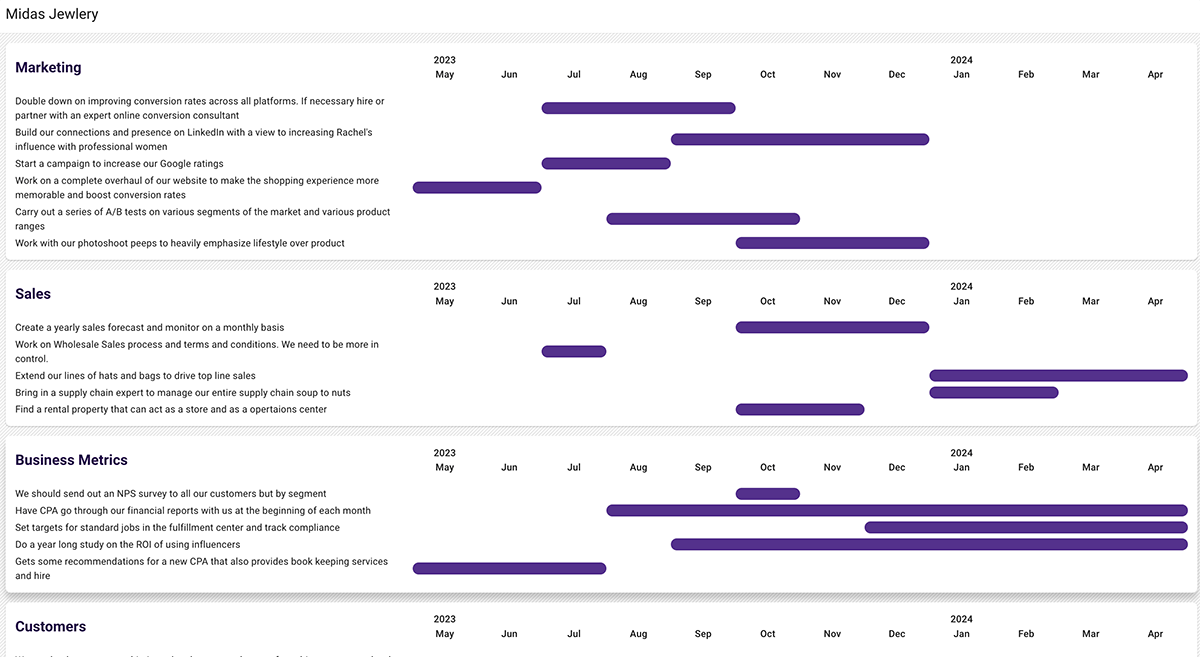
A Gantt chart is a popular tool for visualizing your implementation timeline. It provides a timeline view of tasks, their start and end dates, and how they interrelate. Using software or project management tools, you can easily create a Gantt chart that visually represents your plan’s implementation schedule.  Using automation to keep the entire organization on track to complete the tasks assigned is an excellent idea.  When working with a client I often recommend Ninety.io.  This is a terrific way to keep everyone on track and even sets scheduled check-in meetings with simple agendas to keep everything moving in the right direction.

Allocate Resources

Ensure that you have the necessary resources, including budget, personnel, and equipment, to execute your strategic plan. Resource allocation should align with the milestones in your timeline. If you find resource gaps, address them early to prevent delays.

Monitor and Adjust

Once your implementation timeline is in place, your work is far from over. Regularly monitor progress and be prepared to adjust the timeline as needed. Unexpected obstacles, resource constraints, or changes in the business environment can affect your plan. By staying flexible and adaptive, you can make necessary adjustments to keep the plan on track.  I cannot stress enough the importance of scheduled check-in meetings with set agendas.  Your entire team needs to know they are being held accountable to complete their assigned tasks on time.  If things have gone off track, they need to be out in front of it with an explanation of why they are off track and a plan to get the task completed.

Communicate and Engage

Clear communication is essential throughout the implementation process. Share the timeline with your team and stakeholders. Regularly update them on progress and any changes to the timeline. Engage your team in discussions about challenges and solutions. Effective communication ensures that everyone is aligned with the plan and committed to its success.  Communication should be collaborative, not competitive.  If there is another team that can help, they should be encouraged to jump in.  This is not an individual sport, and you can only win if the entire organization is willing to pitch in to make this a reality.

Celebrate Achievements

As you achieve milestones along the way, take the time to celebrate these accomplishments. Recognizing and rewarding the efforts of your team can boost morale and motivation. It also reinforces the commitment to the overall strategic plan.  Your celebrations should not be limited to the management or leadership group.  Everyone in the company can contribute, even if only in a supportive way.  I will never forget the billing administrator working for me that literally drove revenue by reporting billing progress to the sales and management team throughout the month.  She actively became part of the solution and took pride in her contribution to the overall success of the plan to increase revenue by a percentage or two each month.  A failure to recognize this kind of buy-in would be a catastrophic mistake.  After all it is the employees that accomplish the work not the managers!

Evaluate and Learn

Once your strategic plan has been fully implemented, it’s important to evaluate its success. Did you achieve the intended goals and objectives? What worked well, and what didn’t? Use this evaluation to inform future strategic planning processes and improve implementation timelines for the next cycle.  Feedback is important here; everyone should have the ability to add constructive feedback.  You can make this part of the annual review process.

In conclusion, creating an implementation timeline for your strategic plan is a crucial step in realizing your organization’s long-term objectives. It provides structure, accountability, and a clear path to success. By understanding your plan, setting realistic timeframes, defining responsibilities, and remaining adaptable, you can increase the likelihood of achieving your strategic goals. Remember that the journey from planning to execution is a dynamic process, and a well-crafted timeline will guide you through it effectively.

For help with your business roadmap reach out any time at the TEC Resource Center or build your roadmap with our newly launched Business Roadmap software.  Until next time we wish you much success in whatever path you choose.


Filed Under: Executive Coaching

October 18, 2023 By Pat Meehan

Financial Planning

Welcome to Part 9 of our series on The Power of Strategic Planning.

Introduction

Financial planning is often referred to as the compass that guides a business toward its goals and aspirations. In the complex and ever-evolving world of entrepreneurship, sound financial planning is not just a good practice; it’s an essential pillar of success. In this blog, we’ll explore the critical importance of financial planning for your business and why it should be at the forefront of your strategic considerations.

Goal Setting and Direction

Financial planning helps set clear goals and provides a roadmap for achieving them. By establishing specific, measurable, and time-bound objectives, you give your business a sense of direction. Whether you’re aiming for rapid growth, increased profitability, or debt reduction, financial planning defines the path to reach your desired destination.  Every step of the strategic planning process will have some impact on the financial projections within the plan itself.  Marketing costs, sell price vs. cost of goods sold (COGS), and operational budgets all impact what the financial model will look like.  If you are just starting out, you may not always have these numbers nailed down yet but you need to measure your progress against the best model you can create at the time.

Resource Allocation

Every business operates within limited resources—money, time, and manpower. Financial planning allows you to allocate these resources wisely. It answers questions like, “How much can we invest in new equipment?” or “How many new employees can we hire?” Effective allocation optimizes resource use and maximizes efficiency.

Risk Management

Running a business inherently involves risks. Financial planning helps identify potential financial risks and develop strategies to mitigate them. By forecasting scenarios and stress-testing your financials, you can be better prepared for unforeseen challenges, such as economic downturns or unexpected expenses.  All too often business owners fail to not only create a financial plan but also fail to measure the results they achieve against the plan itself.  Financial parameters in a business can change quickly and as a result, your financial model that was once sound can quickly become obsolete and dangerous.  Just ask those business owners who experience COGS increases of 20% or even 30% during this most recent double-digit inflationary period.

Capital Management

Managing cash flow is vital for business survival. Financial planning helps you anticipate cash needs and ensures that your business has enough liquidity to meet its obligations and seize opportunities. Proper management of working capital can be the difference between thriving and struggling.  There is an expression in business that goes like this – revenue is vanity, profit is sanity, but cash is king.  All three of these categories need to be accounted for in your financial planning.  Understanding the relationship between the three and monitoring them closely is many times the difference between those who succeed and those who struggle to exist.  Not everyone gets the differences here so here is a basic but solid article by QuickBooks that explains them in straightforward terms.  If you have any questions at all, take the time to review them because this is essential.

Investor and Lender Confidence

Investors and lenders often require detailed financial plans before committing capital. A well-thought-out financial plan demonstrates your commitment to fiscal responsibility and provides assurance to external stakeholders. It also helps you secure financing at favorable terms, fueling business growth.  Honestly, you should do this for yourself even if outside financing isn’t required to run the business.  After all, isn’t securing a return on your investment just as important?

Profitability and Sustainability

Financial planning focuses on achieving profitability and sustaining it over the long term. It involves monitoring income, expenses, and profit margins regularly. By aligning your expenses with your revenue, you ensure that your business remains financially viable and profitable.  An income statement is only comprised of three sections you have control over.  Revenue – the money you bring into the business, COGS – the direct costs associated with delivering the product or service, and General administrative (G&A) expenses – the expenses associated with supporting the business (rent, insurance….).  Understanding and managing the relationship between the three drives profitability.  Profitability makes everything else possible.

Operational Efficiency

Financial planning encourages a closer look at your business processes and costs. This can lead to the discovery of inefficiencies that, when corrected, can improve the bottom line. It also facilitates better decision-making by providing data-backed insights into where resources should be invested or trimmed.  Technology can play a major role here.  It can help drive efficiencies or even redirect payroll costs, but when left unmonitored, subscription costs for unused software can creep up and end up dragging profits down.  When working with an organization, I ask to review a report on these expenses and ask three questions.

  • Does this subscription still offer reductions in operational costs?
  • Does the subscription help to attract new customers?
  • Does the subscription cost help to retain existing customers?

If they cannot be tied to one of these, they should be eliminated.  Most clients are surprised at the costs associated with subscriptions, membership, and or software that is no longer used in the growth or improvement of the business.  Try it and see what you can save!

Tax Optimization

Taxes can significantly impact your bottom line. A well-structured financial plan includes tax optimization strategies, which can help minimize your tax liability legally. This leaves more money available for business growth or other strategic initiatives.  Here is a basic but informative article on tax strategies from SCORE that might help.

Adaptation and Agility

In today’s rapidly changing business landscape, adaptability is key. Financial planning allows you to adapt and pivot when necessary. You can adjust your financial plan to respond to changing market conditions, customer preferences, or external factors like a pandemic.

Long-Term Success

Ultimately, the importance of financial planning lies in securing your business’s long-term success. It’s not just about surviving; it’s about thriving, growing, and achieving your vision for your business.

Conclusion

Financial planning is the cornerstone of business success. It empowers you to set and achieve your goals, allocate resources efficiently, manage risks, and adapt to changing circumstances. It is not a one-time task but an ongoing process that evolves with your business. Embrace financial planning as a strategic tool, and you’ll find yourself better equipped to navigate the challenges and opportunities that lie ahead, ensuring a brighter future for your business.  For help with your business roadmap reach out any time at the TEC Resource Center or build your roadmap with our newly launched Business Roadmap software.  Until next time we wish you much success in whatever path you choose


Filed Under: Executive Coaching

October 10, 2023 By Pat Meehan

Creating and Operational Plan

Welcome to Part 9 of our series on The Power of Strategic Planning.

Introduction

A well-crafted strategic plan is a roadmap that guides an organization toward its long-term goals and objectives. While the strategic plan provides the big picture, an operational plan serves as the practical blueprint for achieving those strategic objectives. Think of your strategic plan as the destination, and the operational plan as the step-by-step directions to get there. In this blog, we’ll delve into the importance of creating an operational plan as an integral part of your strategic planning process and outline the steps to create an effective one.

Aligning with Your Strategic Goals

The first step in creating an operational plan is to ensure it aligns perfectly with your strategic goals. Your strategic plan outlines the overarching objectives your organization wants to achieve over a specified period, typically three to five years. The operational plan should break down these objectives into specific, actionable tasks and initiatives that can be executed on a day-to-day, quarterly, and annual basis. This alignment is crucial to ensure that every action taken at the operational level contributes to the realization of the strategic goals.

Establishing Clear Objectives and Key Results (OKRs)

Objectives and Key Results (OKRs) are a valuable tool for setting clear and measurable goals within your operational plan. Each objective should be specific, measurable, achievable, relevant, and time-bound (SMART). The accompanying key results should provide quantifiable metrics that allow you to track progress. For instance, if a strategic goal is to increase customer satisfaction, an operational objective could be to improve response time to customer inquiries by 20% within the next six months. The associated key result would be a measurable metric, such as reducing response time from 24 to 19 hours on average.  Key Performance Indicators (KPIs) can be associated with each step in the response process.  For example, if there are several steps in the response process each of those steps might have time frames associated that will indicate if the response to the customer is on track.  When the KPI is exceeded, an escalation might occur to ensure things stay on track.  There are many on-line tools like Smartsheet and Monday.com that can help keep your team on target.

Identifying Responsible Parties

For an operational plan to succeed, it’s crucial to assign responsibilities to individuals or teams. Each objective and its associated tasks should have a clear owner who is accountable for its execution. This accountability ensures that everyone understands their role in achieving strategic goals and prevents tasks from falling through the cracks.  The entire team needs to be aligned with the overall strategic goals and understand how they play a role in achieving that goal.  All too often plans are drawn up at the senior levels within the organization and never clearly communicated to the team or teams that are responsible for their execution.

Resource Allocation and Budgeting

An operational plan should outline the resources required to execute the tasks and initiatives. This includes budgetary considerations, personnel allocation, technology needs, and any other resources essential for implementation. Accurate budgeting ensures that you can secure the necessary funding and allocate resources efficiently to meet your operational goals.  The technology needed to execute the plan should be addressed before launch to ensure the tools needed by the operational team have been implemented and tested.

Timeframe and Milestones

Set realistic timeframes for achieving the objectives outlined in your operational plan. Establish milestones and checkpoints to monitor progress regularly. By breaking down the strategic goals into smaller, time-bound targets, you can easily track your organization’s performance and adjust as needed.  Establish meeting agendas that address and establish report cards that address the targets directly.  Anything that is off target should be made an issue to be resolved and implemented before the next meeting.

Risk Assessment and Mitigation

Every operational plan should include a risk assessment to identify potential challenges and obstacles that could hinder the achievement of objectives. Once identified, develop strategies to mitigate these risks or, if necessary, create contingency plans to address unforeseen issues.

Communication and Feedback Loops

Effective communication is key to ensuring that everyone within your organization is aware of the operational plan and their respective roles in its execution. Create feedback mechanisms that allow for regular updates, progress reports, and the opportunity to address any challenges or roadblocks.

Performance Measurement and Continuous Improvement

Regularly measure and evaluate the performance of your operational plan. Are you achieving the set objectives and key results? Are there areas where you are falling short, and do you need to make adjustments? Continuous improvement is crucial in ensuring that your operational plan remains flexible and adaptable to changing circumstances.  Establishing a set of strong KPIs can be helpful in this regard.

Staff Training and Development

A critical step in the operational plan is carefully outlining the training and development your staff will require to adequately address the action items in the plan itself.  You need to ensure your team has the skills necessary to accomplish the tasks assigned to them.  Do they understand how to solve the issues your customers might have and what to do if they don’t have the answers?  Are they aligned with the objectives of the plan and ready to execute?  The team needs to believe they can do it if the plan is to be successful.  Spend the time and money necessary to get everyone on board with the plan and give them the training they need to feel confident and comfortable.


Conclusion

An operational plan is a bridge that connects your strategic goals to the day-to-day activities of your organization. It provides the actionable steps and accountability needed to bring your strategic vision to life. By aligning your operational plan with your strategic goals, setting clear objectives and key results, training the team on their assigned responsibilities, and regularly monitoring progress, you can ensure that your organization is on the path to success. Remember that creating an operational plan is not a one-time event; it’s an ongoing process that requires regular review and adjustment to stay aligned with your strategic vision.  For help with your business roadmap reach out any time at the TEC Resource Center or build your roadmap with our newly launched Business Roadmap software.  Until next time we wish you much success in whatever path you choose.


Filed Under: Executive Coaching

September 6, 2023 By Pat Meehan

Identifying Your Ideal Customer

Welcome to Identifying Your Ideal Customer – Part 6 of our series on The Power of Strategic Planning.

Introduction:

A significant portion of your strategic plan will be focused on marketing, pinpointing your ideal customer, and comprehending their pain points.  In part 6 of this series, we will delve into the art of identifying your ideal customer and gaining a deep understanding of their pain points, both of which are essential for crafting compelling marketing messages.  With the number of ads American’s are exposed to each day (between 6,000 and 10,000) it only makes sense to make sure this part of your plan is rock solid.

Step 1: Defining Your Ideal Customer

The foundation of any effective marketing campaign is a crystal-clear definition of your ideal customer. This involves creating detailed buyer personas or profiles that represent the individuals you are targeting. Consider these key elements when defining your ideal customer:

  1. Demographics: Start with the basics, such as age, gender, location, and income. These fundamental characteristics serve as your starting point.
  2. Psychographics: Delve into their lifestyle, values, interests, and behaviors. What drives them? What are their hobbies? What are their core values and motivations?

Step 2: Research Your Audience

To build accurate and meaningful buyer personas, you must conduct thorough research. Here are some valuable research methods to consider:

  1. Surveys and Questionnaires: Gather insights directly from your existing customers or prospective audience through surveys and questionnaires.  This is also a great way to build out your marketing list to be used during the launch of your marketing campaign.  We will discuss this in Part 7 of this series.
  2. Social Media Listening: Monitor social media platforms to discern the topics and issues that resonate with your potential customers.  The best way to get exposed to your potential customers is to engage with them on social media sites of competitors or industry influencers.  By being active on feeds that already have large numbers of followers you can really discern the problems this audience needs solutions to and craft a solution that will give them what they are looking for.
  3. Competitor Analysis: Study your competitors to gain insights into their customer base and discover any unmet needs or underserved pain points.  Read the reviews and look for opportunities to do it better.

Step 3: Understanding Your Ideal Customers Pain Points

Understanding the pain points of your ideal customer is paramount in creating a marketing strategy that truly connects. What is the problem they currently have that they need solutions for? Here’s how to gain insight into their challenges:

  1. Surveys and Interviews: Conduct surveys or one-on-one interviews to probe deeper into the specific problems or challenges your ideal customers encounter in their lives or work.  LinkedIn and other social media platforms allow direct polling that can be very helpful when testing potential solutions to a problem.
  2. Customer Feedback: Pay close attention to feedback from your current customers and that of your competitors. What issues or concerns do they frequently raise?
  3. Online Forums and Communities: Explore relevant online forums and communities where your target audience congregates. Analyze discussions and comments to uncover recurring pain points.  Alignable is the perfect place to ask direct questions of a target audience or listen to the questions asked by others.  Local Mom groups and community forums like Next Door often provide great feedback on what people are having issues with or need solutions too.
  4. Keyword Research: Use keyword research tools like Spyfu or Google to identify the most common search queries related to your industry or niche. These queries often reflect the pain points people are seeking solutions for.

Conclusion:

Identifying your ideal customer and gaining insight into their pain points form the bedrock of a successful marketing strategy which we will cover in more detail in part 7 of this series. When you deeply understand the challenges and issues that your target audience faces, you can tailor your offerings and marketing messaging to offer genuine solutions that resonate with them. This understanding is a dynamic process that evolves as your audience’s needs change, making it an ongoing effort that is well worth the investment. Stop just endlessly posting and engage with your social media audience, you might just uncover the answers you have been looking for.  Ultimately, by empathizing with your ideal customers and addressing their pain points, you pave the way for stronger engagement, brand loyalty, and business growth.  For help with your business roadmap reach out any time at TEC Resource Center or build your own roadmap with our newly launch Business Roadmap software.  Until next time we wish you much success in whatever path you choose.


Filed Under: Executive Coaching Tagged With: Alignement, Ideal Customer, Messaging, Planning, Strategy

  • « Previous Page
  • 1
  • 2
  • 3
  • 4
  • …
  • 17
  • Next Page »

Connect with TEC online!

  • LinkedIn
  • Twitter
  • YouTube

Recent Articles

  • A Lifetime in Healthcare Led Me to a New Mission: Helping Families Age Safely and Independently
  • Q4 Business Planning: Growth Strategies & SMART Goals for the New Year
  • Integrating Business and Personal Life
  • Your Business Exit Strategy – 5 Things to Consider
  • Empowering Growth Through Accountability

Search for Articles by Topic

Recent Articles

  • A Lifetime in Healthcare Led Me to a New Mission: Helping Families Age Safely and Independently
  • Q4 Business Planning: Growth Strategies & SMART Goals for the New Year
  • Integrating Business and Personal Life

Connect with TEC Online!

  • LinkedIn
  • Twitter
  • YouTube

Contact Us

TEC Resource Center
Massapequa, NY 11758
Contact TEC
Phone: 516-241-2063

Copyright © 2026 · TEC Resource Center · All Rights Reserved

Terms of Use | Privacy Policy | Disclaimer

We use cookies to ensure that we give you the best experience on our website. If you continue to use this site we will assume that you are happy with it.